
Last Updated: November 10, 2026
Quick Summary
The best seasonal altar candles depend on your sanctuary’s size, the holder dimensions, how often candles will be lit, and who will maintain them. Measure each holder’s socket diameter before ordering, since diameter matters more than height for a candle to stand straight.
- Measure the socket diameter of every holder, not just one, before ordering altar candles.
- Beeswax burns slowly with a steady flame, while stearine holds color and shape well in storage.
- Liquid candles burn without dripping and suit spaces needing a steady flame in a fixed spot.
- Trim the wick to about a quarter inch before each service and wipe drips while the wax is soft.
- Buy the paschal candle first, since its stand dictates the maximum candle diameter you can use.
Table of Contents
- Types of Church Candles: Altar, Sanctuary, Advent and Liquid
- Advent Candle Sets for Church Use Across the Liturgical Year
- Long-Burning Church Candles: Burn Time, Size and Maintenance
- Flameless Candles for Church Altars and When They Make Sense
- Requesting Pricing and a Tax Exemption Quote from Church Catalog
- Frequently Asked Questions
Choosing the best seasonal altar candles for worship starts with knowing what the space needs.
Start with the setting, not the product.
Next, decide how often the candles will be lit.
Finally, consider who will handle them. Deacons and volunteers trim wicks, change candles and clean drips, so simpler, consistent candles make those tasks easier and keep the altar balanced.
Types of Church Candles: Altar, Sanctuary, Advent and Liquid
Altar candles are the tall, steady candles placed on or beside the altar during worship.
Each type has trade-offs. Traditional wax candles are familiar and widely available but may drip if not sized correctly for their holders.
When comparing options, look at material, diameter, burn time and the holder type your sanctuary already uses.
You can browse our liquid sanctuary candle options to see how they compare with traditional wax for your space.
What each type is actually made of
The material decides how a candle burns, drips and smells, so know it before you compare prices.
- Beeswax is the traditional altar material. It burns slowly with a steady flame and gives off a faint honey scent rather than a chemical one. It is softer than stearine, so a beeswax candle in a warm sanctuary can slump if undersized for its holder, and it costs more per pound than blended wax.
- Stearine (often sold as stearic acid blended with paraffin) is firmer and holds a crisp edge and color. It is the common choice for colored Advent and Lenten sets because dye holds evenly and the candle resists bending in storage. It burns a little faster than beeswax of the same diameter and can smoke if the wick is trimmed too short.
- Paraffin blends are the budget option. They burn brightly and take color well, but lower-grade blends can soot glass holders and leave a film on nearby linens. A blend with a higher stearine content burns cleaner than soft paraffin alone.
- Oil and liquid candles use a refillable glass or metal vessel with a wick assembly. There is no wax pool to tunnel or drip, and the flame height stays consistent until the reservoir runs low. The vessel and refill are a system: you cannot drop a wax candle into an oil holder, and refills must match the manufacturer’s specification.
Matching type to holder and service pattern
Diameter, not height, is what keeps a candle standing straight.
Service frequency should drive the choice as much as appearance:
- Weekly Sunday service only: a mid-diameter wax altar candle gives a good burn life without sitting in storage for months between uses.
- Daily or multi-service schedule: liquid candles or larger-diameter wax candles reduce how often someone has to climb up and swap them.
- Seasonal sets used a few weeks a year: stearine holds color and shape in storage better than soft beeswax, so a colored Advent or Lenten set stays presentable from one year to the next.
- Historic or antique holders: confirm the socket diameter and depth before ordering; a candle that bottoms out in a deep socket can crack the holder as it burns down.
A common pattern in older sanctuaries is a mix of formats: wax on the high altar for tradition, liquid in wall-mounted sconces where changing a candle is awkward, and a matched wax set for the Advent wreath.
Watch out: buying a full set by height alone can lead to fit problems. Two candles listed at the same height can have different diameters.
Advent Candle Sets for Church Use Across the Liturgical Year
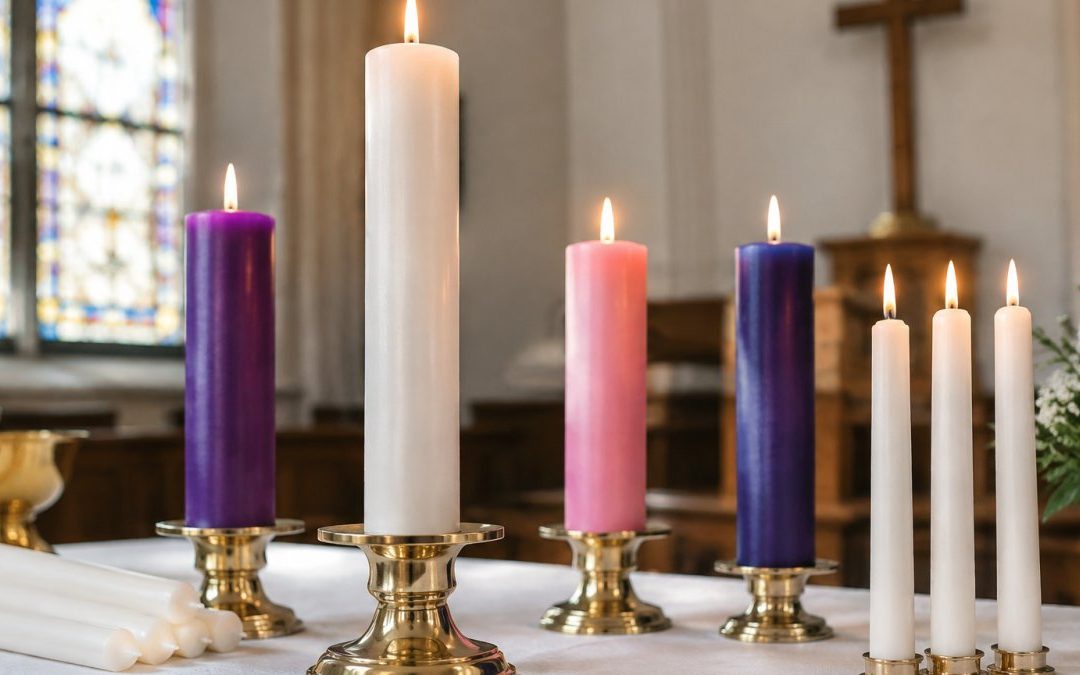
Advent sets are the most visible seasonal candles in many churches.
Advent is not the only season that calls for special candles. Lent, Easter and Christmas each have their own color and placement traditions.
You can view our four-candle church advent set and the 12 x 1 1/2 church advent set to compare sizes for your wreath or stand.
Watch out: mismatched diameters can make an Advent wreath look uneven.
A season-by-season candle plan
A congregation that plans the whole liturgical year can rotate candle sets across the seasons. The table below is a planning framework, not a rulebook; confirm color and count against your own tradition and worship calendar.
| Season or observance | Typical candle count and color | Placement and burn notes |
|---|---|---|
| Advent | Four candles in the wreath (often three violet or blue and one rose, with a white Christ candle at the center) | Light one additional candle each week; the wreath candles burn only during the Advent services, so a mid-diameter set lasts the season |
| Christmas | White candles at the altar and, where used, a white Christ candle | White reads as the feast color; keep spare white altar candles on hand because Christmas services often run longer and burn more hours |
| Epiphany | White or gold accents | Often a short season; reuse the Christmas white set rather than buying a separate one |
| Lent | Violet or unbleached/natural tones, depending on tradition | A somber palette; unbleached beeswax or muted stearine suits the season and hides wax bloom better than bright dye |
| Easter | White, often with a large paschal candle | The paschal candle is typically the largest single candle of the year and is lit at services through the season; size it to its stand before ordering |
| Ordinary Time | Green accents where the tradition uses them, otherwise the standard altar set | The longest stretch of the year, so this is where burn time and replacement frequency matter most |
Planning the rotation so sets last
A few practical habits make a year-round rotation work:
- Buy the paschal candle first. It is usually the largest and most expensive single candle, and its stand dictates the maximum diameter you can use.
- Keep a spare set of white altar candles. Christmas and Easter both call for white, and back-to-back services can burn through a set faster than expected.
- Store colored sets flat and cool. Stearine and beeswax both soften in heat; a colored set stored in a hot closet can warp and no longer seat in its wreath.
- Label sets by season. Mixing a rose Advent candle into a Lenten set is an easy mistake when everything is stored in the same box.
A common pattern is one matched wax set for the main altar through the year, colored sets swapped in for Advent and Lent, and a dedicated paschal candle for Easter.
Watch out: ordering a paschal candle by height alone can leave it too wide for its stand or too narrow to sit securely. Measure the stand’s socket and the clearance above it before you order.
Long-Burning Church Candles: Burn Time, Size and Maintenance
Burn time depends on diameter, wax type and how the candle is lit. A thicker candle generally burns longer and drips less than a thin one of the same height.

Maintenance makes a noticeable difference.
If a candle does not fit an older or antique holder, measure the socket diameter rather than guessing. Our guide to finding candles for antique holders walks through the measurements that matter.
Flameless Candles for Church Altars and When They Make Sense
Flameless candles are an option where open flame is restricted. They produce a soft glow and can suit spaces with sensitive fabrics.
They are not a full replacement for traditional candles in every setting, since many congregations prefer real flame for its movement and tradition. Flameless candles work best as a supplement where a real flame is impractical.
Requesting Pricing and a Tax Exemption Quote from Church Catalog
Pricing for church candles depends on quantity, set configuration, dates and delivery needs, so we do not publish a single price for every item here.
Eligibility for sales tax exemption varies, so confirm your status with the appropriate state revenue department before submitting a request.
To start the process, use our tax exemption request form.
Choosing the right candles for your worship space comes down to fit, burn performance and how the candles will be maintained.
Frequently Asked Questions
Which candle on the altar should be lit first?
Practice varies by parish and denomination, so the safest approach is to follow your own church’s liturgical guidelines or your pastor’s direction. In many churches the central or Christ candle is lit first, followed by the candles on either side. Whatever order you use, keep it consistent from week to week so the lighting feels reverent and familiar to the congregation. Church Catalog can help you select matching altar candle sets that make a consistent arrangement easy to maintain.
What candles are used during Advent?
Advent candles are usually arranged on an Advent wreath or a candle stand and include three violet or purple candles, one rose or pink candle for the third Sunday, and a white Christ candle at the center. Many churches light one additional candle each Sunday of Advent. Advent candle sets for church use are sold in matched sets so the colors and sizes stay uniform across the season. Pricing depends on quantity, timing and delivery, so request a current quote from Church Catalog.
How long should church altar candles burn?
Burn time depends on diameter, wax type and how long each service runs. Burn time varies by candle, so check the product details for the stated burn time. Check the manufacturer’s stated burn time, trim wicks before each use, and avoid letting a flame burn unattended. Replace candles before they reach the base of the holder to keep the arrangement balanced.
Are flameless candles suitable for church altars?
Flameless candles can be a practical choice where open flames are restricted, such as in a room with overhead decorations or in a space with limited ventilation. They do not produce the traditional light and symbolism of a lit candle, so many congregations use them only as a supplement or a fallback. Check with your fire marshal or building authority about local rules before deciding. Church Catalog can advise on which options suit your sanctuary.
