

Last Updated: November 4, 2026
Quick Summary
To find candles for non-standard holders, first measure the socket’s inside diameter across its widest point and its depth. Match that measurement to a candle’s listed base diameter, not its height or top diameter, since the base is the only dimension that determines fit.
- Measure the socket’s inside diameter across its widest point, in inches and millimeters.
- Measure socket depth; a base longer than the depth will stand proud and wobble.
- Compare the socket measurement to the candle’s listed base diameter, not its height.
- A gap of about 1/16 in or less can usually be closed with wax or a thin shim.
- Replace the holder if the socket is cracked, the base is unstable, or the material softens with heat.
Table of Contents
- Finding Non-Standard Taper Candles for Odd Holders
- Making a Candle Fit Safely: Putty, Adapters and Trimming
- Frequently Asked Questions
Finding candles for non-standard holders starts with one step most shoppers skip: measuring the holder first.
Start with the socket, the opening at the top of the holder. Measure its inside diameter across the widest point with a ruler or digital caliper; the socket decides fit, and a loose candle will wobble no matter how well it is made.
Finding Non-Standard Taper Candles for Odd Holders
Taper candles are sold by base diameter, the bottom end that seats in the socket. Taper candles are sold by base diameter, and antique or handmade holders do not always match those standard sizes. Shoppers needing unusual taper sizes can browse Emkay candles sized for sanctuary lamps.
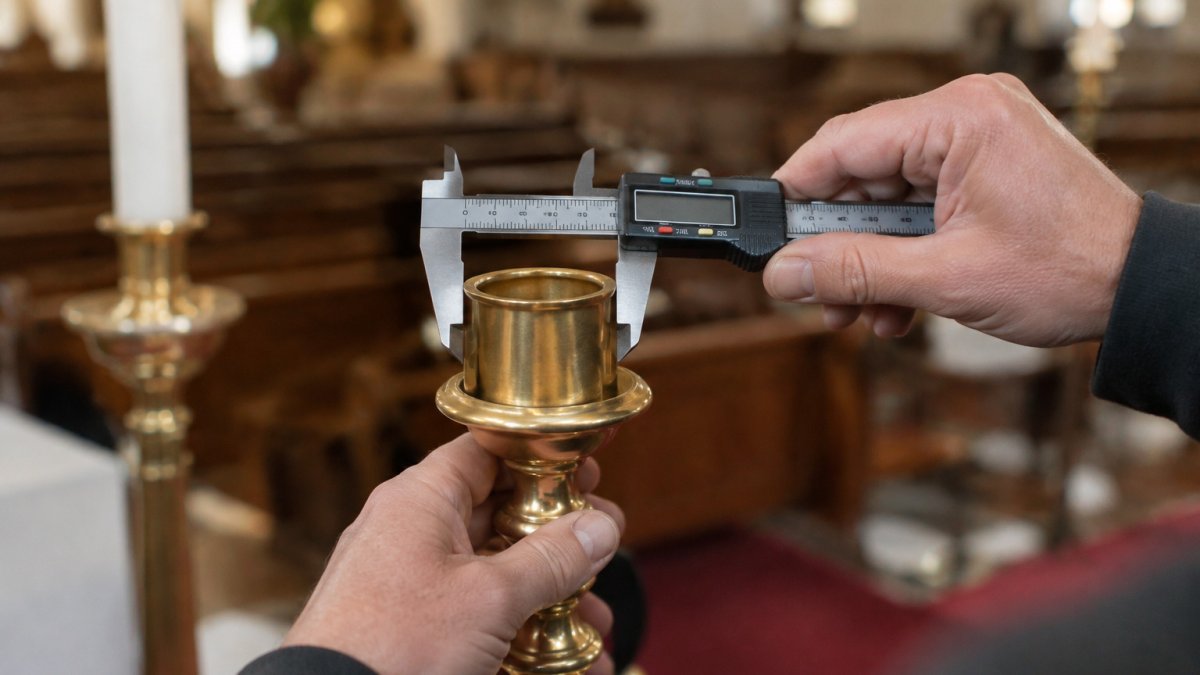
- Measure the socket’s inside diameter across its widest point, in inches and millimeters.
- Measure socket depth; a base longer than the depth will stand proud and wobble. For a complete walkthrough of how to measure socket diameter and match it to candle dimensions, see our sizing and fit guide.
- Measure the base diameter of a candle that already fits well, if you have one.
- Compare your socket measurement to the candle’s listed base diameter, not its height or top diameter.
- Confirm total candle length against how the holder is used, so the flame stays clear of walls and neighboring candles.
A practical compatibility reference for the sizes you are most likely to encounter:
| Socket inside diameter | Typical candle base | Practical option |
|---|---|---|
| About 7/8 in (22 mm) | Standard taper base | Standard taper candles; a thin wax shim if loose |
| About 3/4 in (19 mm) | Slim taper base | Slim tapers; a purpose-made adapter sleeve if the socket is wider |
| About 1 in (25 mm) | Large or church taper base | Large-base tapers; check socket depth before ordering |
| Between two standard sizes | No direct match | Candle putty or a wax adapter to take up the gap |
| Noticeably wider than any taper base | No taper match | Consider a different candle type or a socket insert rather than forcing a taper |
Treat those numbers as starting points, not guarantees. Holders are not always perfectly round or uniform inside, so measure where the candle actually contacts the holder. When your socket measurement does not match a standard listing, ask the supplier for a size chart giving base diameter in inches and millimeters, socket depth, and total length. You can also read about reliable liturgical supply delivery to judge whether specialty candles can be dependably sourced.
Watch out: do not assume a candle labeled ‘standard’ will fit a holder described as ‘standard.’ The only number that decides fit is the base diameter measured against your socket.
Making a Candle Fit Safely: Putty, Adapters and Trimming
When the right candle is close but not exact, a fitting aid can close the gap. The choice depends on how loose the candle is and how much heat the material will see.
Wax shims and softened wax. A small piece of softened wax pressed into the socket takes up a narrow gap, removable, inexpensive, and matching the candle material. Reseat the candle before each use and clear old wax periodically.
Removable adhesive putty. Putty holds a loose candle upright and is easy to remove, but many putties soften near heat and some leave an oily residue. Press a thin ring into the socket rather than a thick plug.
Purpose-made adapters and socket inserts. Adapter sleeves and inserts give the most predictable fit, especially when the gap is large or the holder is valuable.
Trimming the candle base. Trimming is the least reversible option and the one most often done badly. The cut must stay square, an angled cut makes the candle lean. Trim in small increments, test after each, and stop as soon as the candle seats without rocking. If you are unsure how to get the right fit, you can contact the candle store for advice on adapters or candle sizing.
To choose: measure the gap between candle base and socket wall. Roughly 1/16 in or less is usually a job for wax or a thin shim; a larger gap calls for an adapter or insert. If no fitting method holds the candle straight under light hand pressure, the holder, not the candle, is the problem.
Watch out: never trim a candle so much that too little base remains inside the socket, and never build up putty or wax around the top of the socket where it can catch the flame. Test every fitted candle on a stable, heat-resistant surface before service.
Some holders should not be fitted at all. Replace the holder if the socket is cracked, the base is unstable, the material softens with heat, or the socket is so far from any standard size that the candle would need a thick, improvised buildup.
Frequently Asked Questions
How do I measure a candle holder to find the right candle?
Measure the inside diameter of the socket at its opening with a ruler or caliper, then measure the depth. Record the diameter in millimeters or fractions of an inch, since taper candles are sold by base diameter. Compare that figure with the candle’s listed base size, not its overall width, and check whether the socket tapers inward, which can change the effective fit. If the socket is oval or irregular, measure the widest and narrowest points and choose a candle that fits the narrower measurement, then secure it with putty or a wax adapter.
What can I do if a taper candle is too small for its holder?
A candle that is too small for its socket will wobble or lean. Wrap the base with a thin layer of softened candle wax or a wax adapter to build up its diameter, then let it cool before inserting it. Candle putty works well for a loose fit because it can be removed without marking the holder. Avoid forcing a candle that is too large, since that can crack the base or the holder, and choose a candle with a narrower base or trim an oversized base carefully instead.
Can candle putty help stabilize a loose candle?
Yes. Candle putty, also called candle snugger or candle stabilizer, is a reusable tacky material pressed into the bottom of the holder or around the candle base. It holds a loose candle upright and can be lifted out later without residue. Use only a small amount, keep it away from the flame and from the candle’s wick area, and check that it stays put in heat. For a tall candle that leans, press putty at the base on opposite sides to keep it straight.
